exercises in compound storytelling

Showing posts with label Buda's Wagon: A Brief History of the Car Bomb. Show all posts

Sunday, November 30, 2008

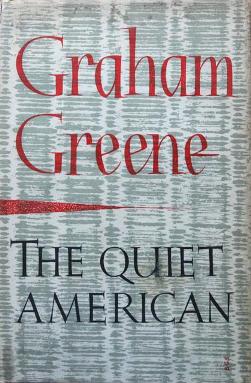
Graham Greene: The Quiet American


Over the holiday I read Graham Greene's 1955 novel The Quiet American, his story of a love triangle set in late colonial Vietnam. I'd already seen the movie, starring Michael Caine and Brendan Fraser, and I have to admit it's a faithful representation of the story. A few pieces of the story are merged for brevity (a couple of Fowler's trips north become one unbroken story), and some characters are perturbed somewhat (imagine trying to explain without a lot of backstory why a particular ethnic Indian in Vietnam's being from Goa matters), but it is a faithful telling of Greene's story. Unfortunately Fraser is in over his head and the Phuong character is little more than an object in Greene's novel, so only Caine as Fowler is left to make the story happen. I don't especially like Michael Caine, but he does well with a fairly difficult character.

The inner story deals with the love triangle (Fowler, Pyle, and Phuong): Fowler is a British reporter living in Saigon, Pyle is an American, a Harvard grad presented as a soulless dupe who may or may not be working for the OSS in the guise of the American Economic Legation, and Phuong is a Vietnamese national trying to leverage her beauty into a trip out of Vietnam.

The outer story deals with American involvement in the latter days of French Indochina, especially in the attempt to set up a Third Force that is neither the French nor the Communists; in particular on the attempt to strengthen a marginal general apparently involved with the Cao Dai by distributing and setting off first bike bombs and then a car bomb. On balance it's a nasty story tightly told: the current Penguin edition weighs in at some 180 pages.

According to Robert Stone, who wrote the introduction for the Greene Centenary edition, Greene sought to portray Fowler as a tortured soul with a rich inner life, Pyle as a soulless American with no inner life, just objectives, and (I suppose) American involvement in Vietnam in the early to mid Fifties as a byproduct of ascendant American strength as expressed through soulless people working out others' ideas with no sense of history and no grasp of the cultures in which they went about their business.

Stone explicitly excludes Colonel Edward Lansdale from being the real-life Alden Pyle, pointing out that Lansdale had not yet arrived in Vietnam by the time Greene finished The Quiet American. This contradicts the claims Mike Davis and others have made (see e.g. this article from Tom's Dispatch), but doesn't really touch the question of the historicity of The Quiet American, much less the question of who introduced vehicle borne improvised incendiary devices into Vietnam.

After reading this book, though, I can't imagine that there were no VBIEDs in Vietnam during the end of the French occupation; it's hard to imagine that Greene invented the whole thing. I'd just question the accuracy of Greene as a primary historical source. To my eyes this is just sloppy work by Davis and it undermines his book Buda's Wagon but doesn't destroy it.

The basis of Stone's claim comes from Norman Sherry's authorized biography of Greene, which says that Greene finished The Quiet American in 1952, despite the fact that the endnote says it was written in Saigon in 1952-1955; Lansdale came to Vietnam from the Philippines in 1954.

Reblog this post [with Zemanta]

Friday, October 10, 2008

Buda's Wagon (postscript)

This past week's episode of ABC Radio National's show The Night Air excerpted an episode of Radio Eye featuring Mike Davis and Buda's Wagon. Grim stuff, but includes Davis's voice, which is more familiar than I expected. Perhaps I've been too hard on the guy.


Reblog this post [with Zemanta]

Thursday, September 25, 2008

Buda's Wagon: "the poor man's air force"

The Quiet AmericanImage via WikipediaI wrapped some work a little early yesterday and had a chance to finish Mike Davis's book Buda's Wagon: A Brief History of the Car Bomb. The book, like the history it covers, descends into lists of dates and body counts once it moves past 1983 or so and deals with the Italian mafia maxi-trials, the Colombian drug cartel wars, the IRA's bombing of the London financial district (now site of the Gherkin), and of course the current Iraq war. It's dismal stuff: it's difficult to tell an ordinary car from a car carrying a small bomb without getting close to it, buildings require visits from delivery trucks and trash trucks, etc. It's virtually impossible to ring a building with enough steel and concrete to keep it outside the blast radius of a very large car bomb, and some of the bombs in this book are just plain huge.

Davis doesn't isolate the nature of the car bomb itself from the bombing stories themselves and I think misses the chance to write a much better book; this would have been better organized if he'd separate the technical aspects of the history of car bombs from the sketched history of resistance: how one group that used car bombs was related to another, the various conflicts, and the movement from anarchism and warfare (New York and Saigon 1920-1955) to urban terrorism.

The theme of the book, the car bomb as the "poor man's air force," gets lost in the details: Davis devotes a chapter early to the concept, and mentions it again late, but the basic idea of the car bomb as the equalizer between occupier and occupied doesn't hold up since the various conflicts don't always have that structure.

I'm glad and relieved to be done with this book.

One closing note: I'm baffled by Davis's treatment of Graham Greene's 1955 novel The Quiet American as a piece of straight reporting. This was an odd editorial choice and suggested to me that Davis isn't overly concerned with facts qua facts, but rather considers what he has to say to be "more true" than the facts he uses to decorate his arguments.

Next up is probably a Deborah Lipstadt book on Holocaust deniers, but I found a copy of Davis's book No One Is Illegal, so I need to give it a look too.


Reblog this post [with Zemanta]

Monday, September 22, 2008

Buda's Wagon

After a busy week last week I got back to reading Mike Davis's book Buda's Wagon: A Brief History of the Car Bomb this weekend. I'm about half-done; this is pretty unpleasant reading, mostly because of the body counts, and a little because of Davis's bizarre point of view.

So far he's traced the history of the car bomb from a horse cart full of dynamite in 1920 up through the use of plastique by Basque separatists. Along the way he's covered the use of bike bombs in Saigon, a couple of chapters on fertilizer-and-heating-oil bombs (e.g. Oklahoma City), and more detailed discussion of the bombing of the "Beruit Hilton" than I'd read anywhere else. There's a recurring theme of the use of explosives stolen from mines, and of course plastique.

Davis is more interested in the political history of car bombs, so he doesn't really deal with the question of what constitutes a car bomb, how it differs from a letter bomb, what technical advances made it possible in the first place, differences between cars as bombs themselves and bombs as sources of shrapnel, etc. Davis seems to be more interested in placing blame, typically at the feet of the late CIA Director William Casey.

All told it makes for pretty grim reading. Honestly I get the impression that car bombs are an unintended byproduct of industrialization and rising living standards, and I hope Davis will eventually take time out from body counts to talk about technical root causes of car bombs rather than proximate political causes.

No analysis from me yet; most of what Davis has to say is data, and I wonder if this is a book that makes more sense within his whole corpus, or if it fits better other books talking about the prosecution of a modern war.

Additional links include

Reblog this post [with Zemanta]

Monday, September 15, 2008

Buda's Wagon

I'm just three short chapters into Mike Davis's short book Buda's Wagon: A Brief History of the Car Bomb. To his credit he tries to tie together all the uses of the car bomb into a single family tree, starting with a cartload of dynamite delivered to Wall Street by an Italian anarchist in 1920. So far it's an odd little book for someone like me who doesn't read much agitprop, especially shall we say left-leaning agitprop.

I forget from time to time that there are people who consider 1920's anarchists to be the good guys fighting for the little people, the nation of Israel to be a fascist regime imposed on native Arabs and Palestinians, etc.

I'm eighteen pages into a two hundred page book. Should be an interesting ride.

Reblog this post [with Zemanta]