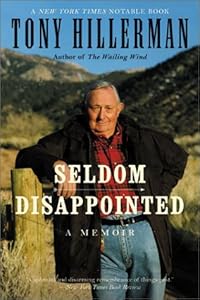
The fourth and final installment of Tony Hillerman's memoir Seldom Disappointed deals primarily with his life as a working writer up to about his seventy-fifth birthday, including a sabbatical at a college in Mexico, the publication of his novels, his misadventures in television and movies, the death of his brother, etc.
Hillerman is disarmingly humble and self-deprecating about his success, making it difficult to be too hard on him: it really seems like after he lived through the Depression and World War II, then got married, adopted several children, and had a successful career before becoming a novelist, that he was genuinely grateful and happy, so the rest of his memoir dealt mostly with explaining a sequence of events: writing and rewriting, finding an agent who understood what he was doing, finding an audience, his generally good relationship with various Indian communities, etc.
There really aren't any deep insights or big controversies in the last quarter of his book. I appreciated his explaining why his books have two heroes (Leaphorn and Chee, rather than Leaphorn or Chee), especially, as he admits, they're hard to tell apart: when he sold the option for his first novel, a clause in the contract guaranteed anyone who bought the option a third time the rights to the Leaphorn character, meaning that Hillerman accidentally found himself partway through his career without ownership of his own character. He mentions more than once that he had to buy Leaphorn back at the cost of $20,000.
His other adventures in Hollywood don't go much better: NBC-TV evidently stiffed him for his expenses after saying they wanted to produce a "desert Hawaii Five-O," but gradually deciding what they really wanted had neither Navajos (per se) nor desert, and they also wanted the hero to have a buxom blond sidekick, meaning they really didn't want anything Hillerman could offer.
That is really the last anecdote of interest; Hillerman more or less looks around at the end and realizes he doesn't have an ending, so he says "well, guess I'll get back to writing" and does. The book ends with a discussion of problems he had to solve in his published novels, a comprehensive bibliography of books he'd written, collected and uncollected stories, books to which he'd contributed, and finally books about him and his work, including several books by crime writer Ken Englade.
This is still a really good memoir: fast-paced, no-nonsense, and very readable. A person could pick worse as a model.
exercises in compound storytelling
Showing posts with label Seldom Disappointed: A Memoir. Show all posts
Thursday, January 14, 2010
Wednesday, January 13, 2010
Tony Hillerman: Seldom Disappointed (part three): Santa Fe and Albuquerque
Last night I finally got into the section of Tony Hillerman's memoir Seldom Disappointed that drew me to this book in the first place: his move to New Mexico and his gradual transition from ordinary schmo to writer.
In the third quarter of his memoir, Hillerman goes to college and majors in journalism, cycles through several Oklahoma papers before being recruited by the news service United Press. UP sends him off to the Santa Fe bureau, where the stories he dictates over the phone are transcribed directly to teletype for distribution to subscribers. When UP decides to have him split his time between Santa Fe (the capitol city) and Albuquerque (the only metropolitan center of any size) an hour away, Hillerman quits UP and enrolls at the University of New Mexico, where he is immediately drafted as an assistant to the President of the University. His job at UNM is to help the President deal with the press, and, occasionally, the same political figures in Santa Fe Hillerman had just left.
Hillerman's understated style in this section is at its best: he manages to capture the old-boy-network Third-World aspect of New Mexico in the Fifties deftly and economically, and he even captures the magical-realism of the Cricket Coogler murder and its implications without losing his own distinctive reporterly voice.
Hillerman makes the transition from graduate student to UNM faculty and from state politics to university faculty politics, adopts several children, and begins to make the transition from academic to writer; at the end of this section he's beginning to discuss but not actually write the first of his Navajo Country novels and has sketched sections from a couple of others. It's hard to fathom that with a quarter of the book to go he still has forty years to live and more than fifteen books to write.
This is the section of the book that actually seems joyful and amused at how well his life is turning out, and at the risk of falling back on cliche I have to say it's a joy to read. Hillerman's novels sometimes plod and are generally underimagined, and even he understands he's a man of limited talent as a fiction writer (he has trouble with believable villains, struggles with romance, etc.) but as an essayist (The Great Taos Bank Robbery) and a memoirist he's much better, even with his deadpan delivery and lean prose.
If everything goes well I'll wrap this book up tonight; I'm looking forward to reading the rest of it, but not looking forward to being done.
In the third quarter of his memoir, Hillerman goes to college and majors in journalism, cycles through several Oklahoma papers before being recruited by the news service United Press. UP sends him off to the Santa Fe bureau, where the stories he dictates over the phone are transcribed directly to teletype for distribution to subscribers. When UP decides to have him split his time between Santa Fe (the capitol city) and Albuquerque (the only metropolitan center of any size) an hour away, Hillerman quits UP and enrolls at the University of New Mexico, where he is immediately drafted as an assistant to the President of the University. His job at UNM is to help the President deal with the press, and, occasionally, the same political figures in Santa Fe Hillerman had just left.
Hillerman's understated style in this section is at its best: he manages to capture the old-boy-network Third-World aspect of New Mexico in the Fifties deftly and economically, and he even captures the magical-realism of the Cricket Coogler murder and its implications without losing his own distinctive reporterly voice.
Hillerman makes the transition from graduate student to UNM faculty and from state politics to university faculty politics, adopts several children, and begins to make the transition from academic to writer; at the end of this section he's beginning to discuss but not actually write the first of his Navajo Country novels and has sketched sections from a couple of others. It's hard to fathom that with a quarter of the book to go he still has forty years to live and more than fifteen books to write.
This is the section of the book that actually seems joyful and amused at how well his life is turning out, and at the risk of falling back on cliche I have to say it's a joy to read. Hillerman's novels sometimes plod and are generally underimagined, and even he understands he's a man of limited talent as a fiction writer (he has trouble with believable villains, struggles with romance, etc.) but as an essayist (The Great Taos Bank Robbery) and a memoirist he's much better, even with his deadpan delivery and lean prose.
If everything goes well I'll wrap this book up tonight; I'm looking forward to reading the rest of it, but not looking forward to being done.
Tuesday, January 12, 2010
Tony Hillerman: Seldom Disappointed (part two): World War II
Tony Hillerman wasn't drafted, and in fact because once his older brother was drafted he was the sole remaining son of a widow he was exempt from the draft, but once he failed to make a go of college the first time he essentially volunteered for the infantry. The second quarter of his memoir Seldom Disappointed covers his time in the Army, his convalescence, and his return to civilian life.
Hillerman is the first writer I've read whose account of World War II sounded anything like Joseph Heller's novel Catch-22: reserve troops are sent on fool's errands, replacements are killed minutes after arriving, Army intelligence is almost never right, and officers are generally well-fed and unconcerned with the health and well-being of their men.Most of Hillerman's anecdotes involve marching from one place to another with inappropriate armaments and gear, losing weapons or gear, sloshing through mud, digging foxholes, lying in the mud in foxholes, and getting up the next day to do the same thing in a different direction. He serves out his tour of duty in Europe, skirts the Battle of the Bulge, is awarded the Bronze Star and the Silver Star, steps on a land mine and loses his sight, and is finally sent Stateside at the end of the war for surgery that is abruptly canceled when he is discharged.
On his return Hillerman is impressed with the way a journalist mills segments of his letters to his mother into a passable newspaper article about him and decided to invest his access to education due to the GI Bill to become a journalist, "whatever that was," and a chance encounter with some Navajos in ceremonial dress in the Four Corners area apparently completes the outline of the rest of his life.
I am repeatedly surprised at the balance between the gratitude Hillerman shows for how one accident after another improves his lot in life, and how his primitive Catholicism frames his generally decent behavior day to day, but how these two elements of his outlook never quite coalesce: it's as if God lives somewhere else and Hillerman communicates with Him via a ritual once in a while, while the luck bordering on grace that shapes his life doesn't demand explanation. I sometimes wonder if how much of this missed connection is late artifice by the older Hillerman and how much of it is a fair representation of his state of mind fifty years earlier.
Hillerman is the first writer I've read whose account of World War II sounded anything like Joseph Heller's novel Catch-22: reserve troops are sent on fool's errands, replacements are killed minutes after arriving, Army intelligence is almost never right, and officers are generally well-fed and unconcerned with the health and well-being of their men.Most of Hillerman's anecdotes involve marching from one place to another with inappropriate armaments and gear, losing weapons or gear, sloshing through mud, digging foxholes, lying in the mud in foxholes, and getting up the next day to do the same thing in a different direction. He serves out his tour of duty in Europe, skirts the Battle of the Bulge, is awarded the Bronze Star and the Silver Star, steps on a land mine and loses his sight, and is finally sent Stateside at the end of the war for surgery that is abruptly canceled when he is discharged.
On his return Hillerman is impressed with the way a journalist mills segments of his letters to his mother into a passable newspaper article about him and decided to invest his access to education due to the GI Bill to become a journalist, "whatever that was," and a chance encounter with some Navajos in ceremonial dress in the Four Corners area apparently completes the outline of the rest of his life.
I am repeatedly surprised at the balance between the gratitude Hillerman shows for how one accident after another improves his lot in life, and how his primitive Catholicism frames his generally decent behavior day to day, but how these two elements of his outlook never quite coalesce: it's as if God lives somewhere else and Hillerman communicates with Him via a ritual once in a while, while the luck bordering on grace that shapes his life doesn't demand explanation. I sometimes wonder if how much of this missed connection is late artifice by the older Hillerman and how much of it is a fair representation of his state of mind fifty years earlier.
Subscribe to:
Posts (Atom)

![Reblog this post [with Zemanta]](http://img.zemanta.com/reblog_c.png?x-id=832acda5-82eb-4e24-a27a-402f2323a2c2)
![Reblog this post [with Zemanta]](http://img.zemanta.com/reblog_c.png?x-id=d11ada3b-c8d4-4cba-ba47-711e6f90834c)
![Reblog this post [with Zemanta]](http://img.zemanta.com/reblog_c.png?x-id=db5e7f43-9f16-4545-89cf-78b74bdc6e7b)
