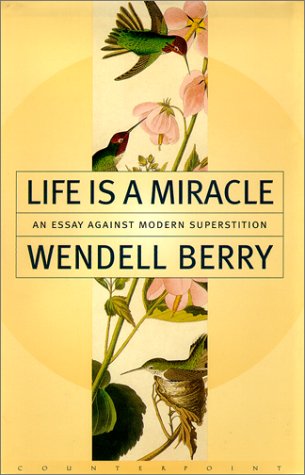
If I were to dig through this essay and find those thousand words, this section would probably be among them:
There is no reason, as I hope and believe, that science and religion might not live together in amity and peace, so long as they both acknowledge their real differences and each remain within its own competence. Religion, that is, should not attempt to dispute what science has actually proved; and science should not claim to know what it does not know, it should not confuse theory and knowledge, and it should disavow any claim on what is empirically unknowable.And when Berry sets out to explain how he would set out to reconstruct the social order to keep science away from religion (and away from art) he starts here:
And how might this come about? Again, I have to say that I don't know. I don't like or trust large, official programs of improvement, and I don't want to appear to be inviting any such thing.This first quote is close to Berry's main theme: science as we currently understand it is basically soulless, and ruins everything it touches. The second half of this essay Berry devotes to suggesting that science has nothing helpful to say about religion or art, because they are fundamentally about different things, express themselves differently, and value different things. This is at its heart a helpful argument up to a point: we live in a society that claims to value both science and art, but in Berry's mind Wilson and his ilk believe that art is properly within the domain of science, and that left to their own devices they would do something horrible to it. Unfortunately Berry seems to be continually making unfair comparisons: between science (and scientism) at its worst versus an idealized art, and between a future science that is worse and more threatening versus a religion that has been repaired of all its flaws.Frankly this reminds me of the sort of arguments I hear between socialists and capitalists: the socialists want to talk about the excesses and abuses of capitalism as it is vs. the idealistic goals of socialism, while the capitalists want to talk about the theoretical freedoms capitalism offers vs. the excesses of totalitarian states with nominally socialist governments.
I don't know what to make of this: I have to agree with Berry that Something Is Horribly Wrong, and I have to agree with him that simply transferring the power to remake society from one evil system to another won't give us what we all want: a more stable, more diverse, less self-destructive world. Unfortunately I find his arguments appalling: not just wordy and mostly vacuous, but devoid of real remedies.
Berry never makes the argument that what the world needs is better people, so he's left talking about better systems: namely, universities need to be more united and self-critical. Berry suggests that universities have made a deal with the Devil by allowing themselves to fracture into disciplines that never cross-cooperate or cross-communicate, much less cross-criticize. He points out that universities have art critics but no farm critics or industry critics, and suggests that it lacks the latter because corporate and industrial concerns have purchased the silence of the university as a whole. This is an apt observation as far as it goes, but what Berry overlooks is the natural human tendency for university professors to avoid controversy and responsibility. He doesn't ask the question of whether university faculty are corrupt because they are university faculty, or whether they are corrupt because they are university faculty. So while the changes he envisions for society value the individual he never identifies the individual responsibilities to which his systemic reforms devolve.
As an aside, I have to point out that here again Berry is railing against an imaginary university. He chooses Wilson as representative of the evil overreaching scientist, but he never identifies a university that is guilty of the particular sins he lists. As a result he's stuck: either as an authority on universities (which he isn't) or appealing to our prejudices about universities (which may or may not be fair). This would have been a much better book if he'd described the history of the infiltration and downfall of a particular university, complete with names and dates. As it is I'm left wondering if he's even found the right culprit, or if instead the problems he identifies are symptoms of something deeper and more widespread.
Berry is fundamentally grappling with the relationship between the individual and the collective, or more accurately, the individual and the statistical distribution to which it contributes. He asks some worthwhile questions, and I find myself wondering whether he does a better job elsewhere; these are good questions asked poorly and reiterated ad nauseam.
![Reblog this post [with Zemanta]](https://lh3.googleusercontent.com/blogger_img_proxy/AEn0k_sK4Op-sLd4R27W4BSwV_OAjIlIdUFhv9wetiPoircQQIAhl54a9y7ZYOaBsL-w7quWTS3f64qL1wGWakR9OCplGFn0GPYvnyoJT99vo21gihEfcXJCPbdF2JRseYbE_wz9rSLKzso_qONmSJdANsaU=s0-d)


![Reblog this post [with Zemanta]](https://lh3.googleusercontent.com/blogger_img_proxy/AEn0k_sCVCWRyxqs_KKFlRH7etgNrEjoznEW9CZYXpUxS1H0hv1IQBo-EwT3ghtisdQp8FQ99b1UBNeXgyvi7EhqoagGC1VmrpEC0Hp_I-tjbd3ffUL10RtDVFNNth-z3MyBA-rFzsQ52f1so-JoP0MgQsqT=s0-d)


