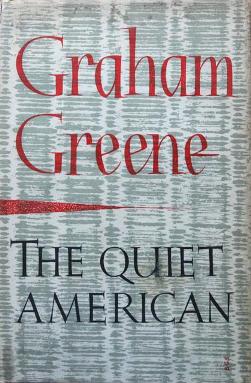
Over the holiday I read Graham Greene's 1955 novel The Quiet American, his story of a love triangle set in late colonial Vietnam. I'd already seen the movie, starring Michael Caine and Brendan Fraser, and I have to admit it's a faithful representation of the story. A few pieces of the story are merged for brevity (a couple of Fowler's trips north become one unbroken story), and some characters are perturbed somewhat (imagine trying to explain without a lot of backstory why a particular ethnic Indian in Vietnam's being from Goa matters), but it is a faithful telling of Greene's story. Unfortunately Fraser is in over his head and the Phuong character is little more than an object in Greene's novel, so only Caine as Fowler is left to make the story happen. I don't especially like Michael Caine, but he does well with a fairly difficult character.
The inner story deals with the love triangle (Fowler, Pyle, and Phuong): Fowler is a British reporter living in Saigon, Pyle is an American, a Harvard grad presented as a soulless dupe who may or may not be working for the OSS in the guise of the American Economic Legation, and Phuong is a Vietnamese national trying to leverage her beauty into a trip out of Vietnam.
The outer story deals with American involvement in the latter days of French Indochina, especially in the attempt to set up a Third Force that is neither the French nor the Communists; in particular on the attempt to strengthen a marginal general apparently involved with the Cao Dai by distributing and setting off first bike bombs and then a car bomb. On balance it's a nasty story tightly told: the current Penguin edition weighs in at some 180 pages.
According to Robert Stone, who wrote the introduction for the Greene Centenary edition, Greene sought to portray Fowler as a tortured soul with a rich inner life, Pyle as a soulless American with no inner life, just objectives, and (I suppose) American involvement in Vietnam in the early to mid Fifties as a byproduct of ascendant American strength as expressed through soulless people working out others' ideas with no sense of history and no grasp of the cultures in which they went about their business.
Stone explicitly excludes Colonel Edward Lansdale from being the real-life Alden Pyle, pointing out that Lansdale had not yet arrived in Vietnam by the time Greene finished The Quiet American. This contradicts the claims Mike Davis and others have made (see e.g. this article from Tom's Dispatch), but doesn't really touch the question of the historicity of The Quiet American, much less the question of who introduced vehicle borne improvised incendiary devices into Vietnam.
After reading this book, though, I can't imagine that there were no VBIEDs in Vietnam during the end of the French occupation; it's hard to imagine that Greene invented the whole thing. I'd just question the accuracy of Greene as a primary historical source. To my eyes this is just sloppy work by Davis and it undermines his book Buda's Wagon but doesn't destroy it.
The basis of Stone's claim comes from Norman Sherry's authorized biography of Greene, which says that Greene finished The Quiet American in 1952, despite the fact that the endnote says it was written in Saigon in 1952-1955; Lansdale came to Vietnam from the Philippines in 1954.
![Reblog this post [with Zemanta]](https://lh3.googleusercontent.com/blogger_img_proxy/AEn0k_vd0Nwvbn_1eFUwiTvGiZDACDNgtqtZ24mERiCyxAjdnhIhdIkh8g__8GmCjTSF1ZiQapaDx6eyZYd_MC8s_3o1msXjstGWnl6kjrjwu8ni9R_T0BkZpzLHFSHHF5Oen0UCnIFX0MTkRosCga2hsSBC=s0-d)


![Reblog this post [with Zemanta]](https://lh3.googleusercontent.com/blogger_img_proxy/AEn0k_tW-c_BgSmrTFJyeCGl-51PBsmt2TxTY9rBIIiBVfdm0H4CbqKsch5FVn1UxyZnMhtoJNqZ9haDcv-2GmY_XYE35uetT0oDgIxz_rzMSw-yIYWVRUergjZxjXxG_5uKFvuKPzH4UwTMTvst0oCi6jZz=s0-d)


